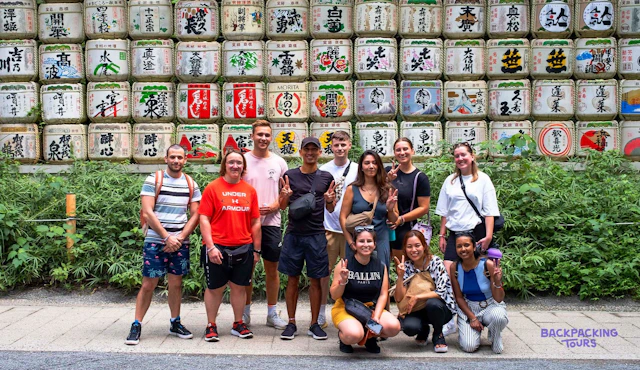
In short: Our 17-day Backpacking Japan: Expedition runs Tokyo to Osaka by bullet train, stopping in Nagano, Hakone, Osaka, Koyasan, Kyoto and Hiroshima. It is a small-group trip for 4 to 16 travellers, mostly aged 20 to 45, with all in-country transport, 16 nights of accommodation and 20 meals included.
Japan is the country people save for last and then wish they had done first. It is also the one most travellers get wrong, because the temptation is to pick two cities, fly between them and call it a trip. The whole point of Japan is what sits in between: the mountain town, the temple you sleep in, the island you reach by ferry, the bowl of noodles at a station counter at eleven at night.
That is what our 17-day Japan Expedition is built around, and the thing that makes it possible is the railway. Here is the route, how you actually move along it, and the handful of days people still talk about months afterwards.
North first, to the mountains at Nagano. Then south past Mount Fuji to Osaka, up to the temple town of Koyasan, on to Kyoto, and west to Hiroshima before the run back. Each stop carries the days you spend there.
Getting around: Japan by bullet train
There are no internal flights on this trip. Every long hop is made on the Shinkansen, the bullet train network that opened in 1964 and has been quietly embarrassing the rest of the world ever since. The fastest services run at up to 320km/h, or close to 200mph, and the whole thing is timetabled to the minute and famously kept there: average delays on the main line are measured in seconds rather than minutes.
The bullet train, waiting on the platform
What that means on the ground is that the travel days stop being travel days. Tokyo to the mountains of Nagano takes the time of a long lunch. Kyoto to Hiroshima happens between breakfast and the middle of the morning. You board with a coffee, watch rice paddies and tunnels go past at a ridiculous speed, and get off somewhere that looks nothing like where you started, with the afternoon still ahead of you.
The rest is filled in by everything else Japan runs: local trains out to Nara for the afternoon, a cable car above Hakone for the Mount Fuji views, a pirate ship across Lake Ashi (yes, really) and a ferry over to Miyajima. All of it is included in the trip, all of it is booked by your leader, and nobody in the group ever has to stand in front of a ticket machine working out which of nine buttons means "two adults".
What kind of trip this is
It is a small-group backpacking trip, not a coach tour and not a guided march. Groups run from 4 to 16 people, most travellers are between 20 and 45, and the majority book on their own and leave with a group chat that outlives the trip. A leader travels with you the whole way, with local guides joining for the things that deserve one, like the samurai class and the monks' morning fire ceremony.
Mount Fuji from Hakone, on a clear morning
Where you sleep changes as often as where you are. Most nights are hostels in the cities. Two are in a traditional ryokan in Nagano, on tatami mats under a futon, with an onsen to sink into. One is in a working Buddhist temple in Koyasan. Twenty meals are included, and the ones that are not are the best part of the budget: Japan is a country where a bowl of ramen at a station counter can ruin you for ramen everywhere else.
All in-country transport and bullet trains, 16 nights of accommodation, 21 activities and your leader are in the price. International flights, travel insurance and airport transfers are not.
The days people remember
The snow monkeys at Jigokudani. An hour into the mountains from Nagano there is a valley where wild Japanese macaques climb down to a hot spring and sit in it, up to their necks, with expressions of complete contempt for everyone watching. They are there all year, but in winter, with snow on their heads and steam coming off the water, it is one of the strangest and best things you will see anywhere.
Snow monkeys in the hot springs at Jigokudani
A night with the monks in Koyasan. Koyasan is a temple town on a forested mountain, founded more than 1,200 years ago, and you do not visit it so much as stay in it. You sleep in temple lodgings, eat the monks' own vegetarian cooking, and walk after dark through Okunoin, the largest cemetery in Japan, under stone lanterns and towering cedars. In the morning you are up early for the prayers and the fire ceremony, and then breakfast is served by the people who just performed it.
Dinner with the monks in Koyasan
Kyoto, given four nights instead of one. Most itineraries give Kyoto a day and a half and call it done. This one stays for four, which is what it takes to walk the bamboo of Arashiyama early enough to have it to yourself, climb the vermilion torii gates of Fushimi-Inari, stand in front of the Golden Pavilion, be taught to hold a sword properly, and still have an evening free to get lost in Gion.
Arashiyama's bamboo grove, Kyoto
Hiroshima, and then Miyajima. The Peace Memorial Park, the museum and the Atomic Bomb Dome are a hard morning, and they are not optional in any sense that matters: you cannot understand modern Japan without them. The next day you take the ferry across to Miyajima, where the great red torii gate of Itsukushima Shrine stands out in the bay and looks, at high tide, like it is floating. The two days sit next to each other on purpose.
The floating torii gate at Miyajima
And the ordinary things. Rolling your own sushi with a sushi master in Tokyo and eating the evidence. Folding origami in Nagano and making soba noodles by hand. Wearing a yukata down the street to the baths. Karaoke in Osaka at an hour you will not admit to. Feeding a cracker to a bowing deer in Nara. None of these are the reason anyone books Japan, and all of them are what people talk about afterwards.
Yukata robes in the streets of Shibu Onsen
When to go
Japan has four genuinely distinct seasons and the trip reads differently in each. Spring brings the cherry blossom and the biggest crowds; autumn brings the maples and the most reliable weather; winter puts snow on the monkeys and the mountains; summer is hot, green and the only season that opens up Shiga Kogen National Park. Our month-by-month guide to Japan's weather breaks down what each one actually feels like. Worth checking your entry requirements for Japan before you book, too, since they depend on the passport you hold.
No. All in-country transport and bullet trains are included in the trip price, and your leader holds the tickets. A rail pass is only worth pricing up if you are adding independent travel before or after the tour, and even then it is worth comparing it against point-to-point tickets for the journeys you actually plan to make.
How much luggage can I take on a bullet train?
A backpack is ideal: it goes on the overhead rack and travels with you. Large wheeled suitcases are where people come unstuck, because on several Shinkansen lines any bag over 160cm in total dimensions (height plus width plus depth) needs a reserved oversized-baggage space, booked in advance. Stations also have coin lockers everywhere, which is how most of the group handles a day trip.
When is the best time to do this trip?
Spring and autumn are the classic answers, for blossom and maples respectively. Winter is the one to pick if the snow monkeys in the hot springs are your reason for going, and summer is the only season that includes Shiga Kogen National Park. Our Japan weather guide goes month by month.
Who else will be on the trip?
Groups run from 4 to 16 people and most travellers are aged 20 to 45. The majority book solo, which is the normal way to join one of our trips rather than the exception. A group leader travels with you for all 17 days, with local guides for the specialist activities.
Seventeen days, seven stops, one railway. If that is the trip you want, the dates, the price and the full day-by-day are on the Backpacking Japan: Expedition page. If you have less time, the 13-day Japan Essentials runs the same spine, Tokyo to Hiroshima, without the Nagano mountains and the night in Koyasan.
Your next trip starts here
Ready to see Japan for yourself? Let's go!
We run 4 trips in Japan — and 29 more countries besides. Your next adventure is waiting.
Pop your name and email in and we’ll send a voucher code straight to your inbox.
By signing up you agree that we may occasionally send you marketing emails. This voucher code is for new bookings only.
We use cookies
They keep the site running, remember your currency and help us show you trips you’ll actually want. Accept all for the best experience, or read our cookie policy.
Strictly necessary
Always on
Logins, your basket and keeping the site secure. Can’t be switched off.
Functional
Our live chat, so a conversation with the team carries on from page to page.
Analytics
Lets our own stats recognise your browser from visit to visit. Without it we only count visits anonymously.
Marketing
Lets us show you relevant trips on social media and other sites, and see which ads work.